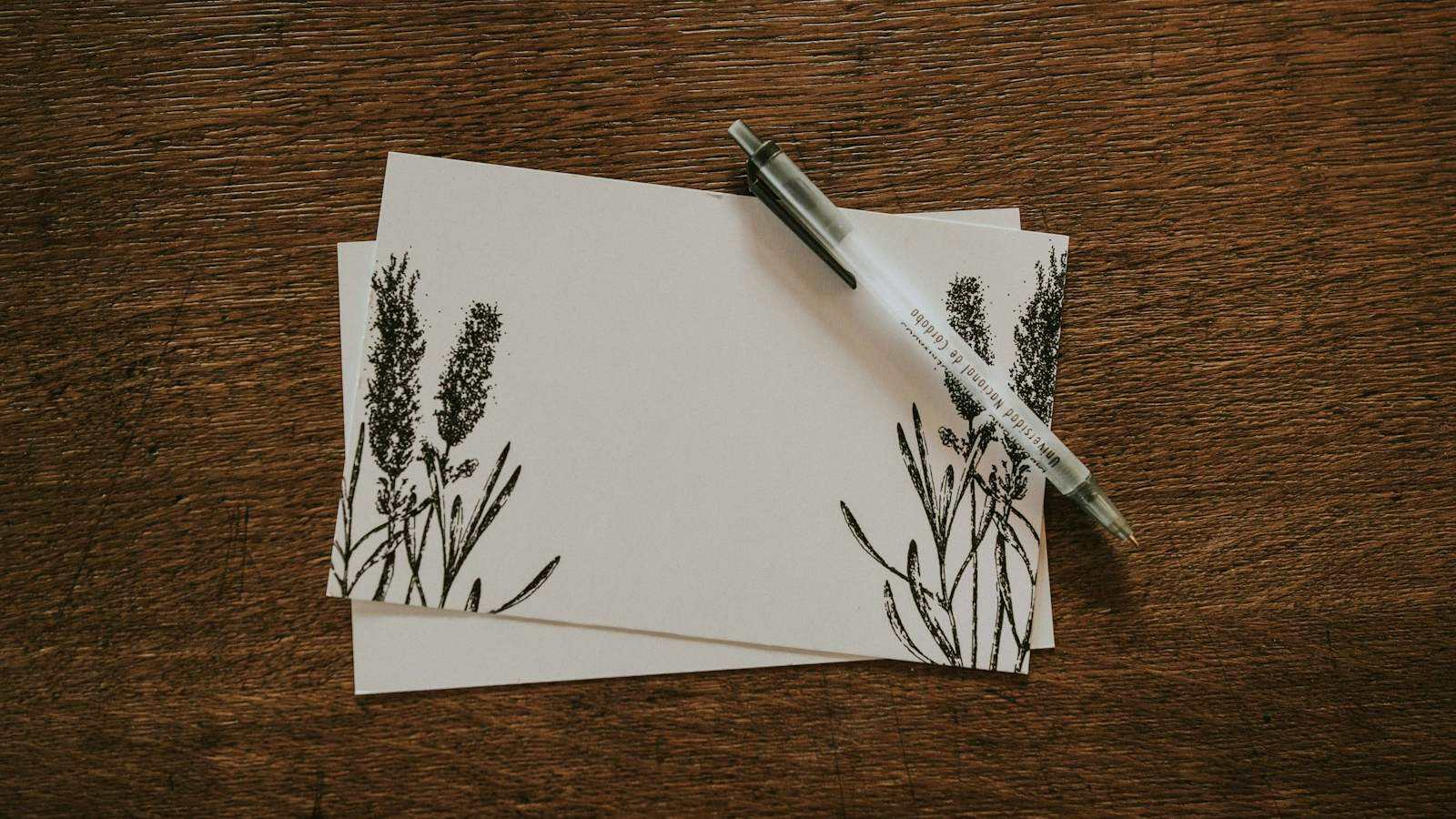
Funeral memory cards are small cards on which guests write one memory of the person who passed away. They sit on the tables or by the guest book with pens and a basket. The family reads them afterward, and many keep them in a box or bind them into a book.
Why families use them
A blank guest book page makes people freeze. A small card with one prompt feels easy, and guests can write it at their table, at their own pace.
The family ends up with dozens of stories instead of a list of signatures, often including ones they've never heard.
Where to put them
Put a few cards and pens on each table at the reception, and a stack beside the guest book at the entrance. Add a basket or box labeled "Memories for the family".
Ask the person leading the service to mention them once. That single sentence doubles how many come back.
Prompts to print on the cards
One prompt per card is enough. Mix a few different ones across the tables so the memories cover different sides of the person.
My favorite memory of you is…
You taught me…
I'll always remember the time…
Something about you that made me smile:
Examples of what guests write
Most memories are one to three sentences. Small, specific moments are what families treasure.
You let me drive your truck when I was fourteen and made me promise not to tell Grandma. I never did.
Every Wednesday you saved me the corner piece of the cornbread. Thank you for making me feel like family.
You taught me to fish, to say sorry first, and to always bring a sweater. I still do all three.
Memory cards with a QR code
Some memory cards carry a QR code on the back. Guests can write on the card, or scan it to type a longer memory, add a photo or record a short voice note from their phone.
It also lets people who couldn't come share a memory later, from the same link.
After the service
Read them together as a family, when you're ready. Many families keep them in a box with the guest book, or scan them into a memorial book so every household gets a copy.
If someone wrote a story you didn't know, consider sending them a short thank-you note. It means a lot.
How many and what size
Plan one card per expected guest plus about twenty spares. Business-card to postcard size works well; anything larger feels like a letter and slows people down.
Thick, uncoated paper takes ink from any pen without smudging. Test your pens on one card first.
Making your own
You can print simple cards at home on card stock: their name at the top, one prompt, and lines to write on. Four to a page, cut with a paper trimmer.
Add their photo in a corner, or keep them plain. Either feels personal when the handwriting fills them.
For a celebration of life
At a relaxed gathering, put cards on every table with a jar for each. People write more when they’re sitting with friends and sharing stories already.
Some families read a few aloud at the end of the gathering, with permission. It often becomes the most remembered moment of the day.
Cards for people who couldn’t come
Mail a card with a stamped return envelope to relatives far away, or send them a link where they can type a memory instead.
Late memories are welcome. Some of the best arrive weeks after the service.
Reading them together
Choose a quiet evening after the service and read the cards aloud as a family. Many families say it was the first time they laughed since the loss.
Keep the ones that mean most in a frame or a book. Some families tuck one into each thank-you card they send back.
Wording for the front of the card
The front can carry their name and dates, a photo, or a short line. Keep it simple so the back stays the focus.
In loving memory of Margaret Hayes, 1941–2026
Share your favorite memory of Tom
Remembering Rosa, with love
Putting the cards in a book
Scan or photograph the cards and arrange them in a memorial book, with a page for each card or a few per page. The handwriting is part of the gift, so keep the images of the cards rather than retyping them.
Add photos from the service and the guest book signatures, and every household can have the same keepsake.
Questions people ask
What do you write on a funeral memory card?
One short memory: a moment, a habit, something they taught you. One to three sentences is perfect.
How many memory cards do I need for a funeral?
About one per guest, plus a few spares. Unused cards can be mailed to people who couldn't come.
Where do memory cards go at a funeral?
A few on each reception table and a stack by the guest book, with pens and a labeled basket for finished cards.
Memorabilia's Share-a-Memory cards carry your loved one's photo on one side and a QR code on the other, so guests can write or scan to share. From $89.99 for 50, boxed with a table sign.
Gather memories from everyone at the service
One QR code on the memory table. Guests add stories, photos and voice notes from their phone in a minute, with no app. The family approves everything first.